

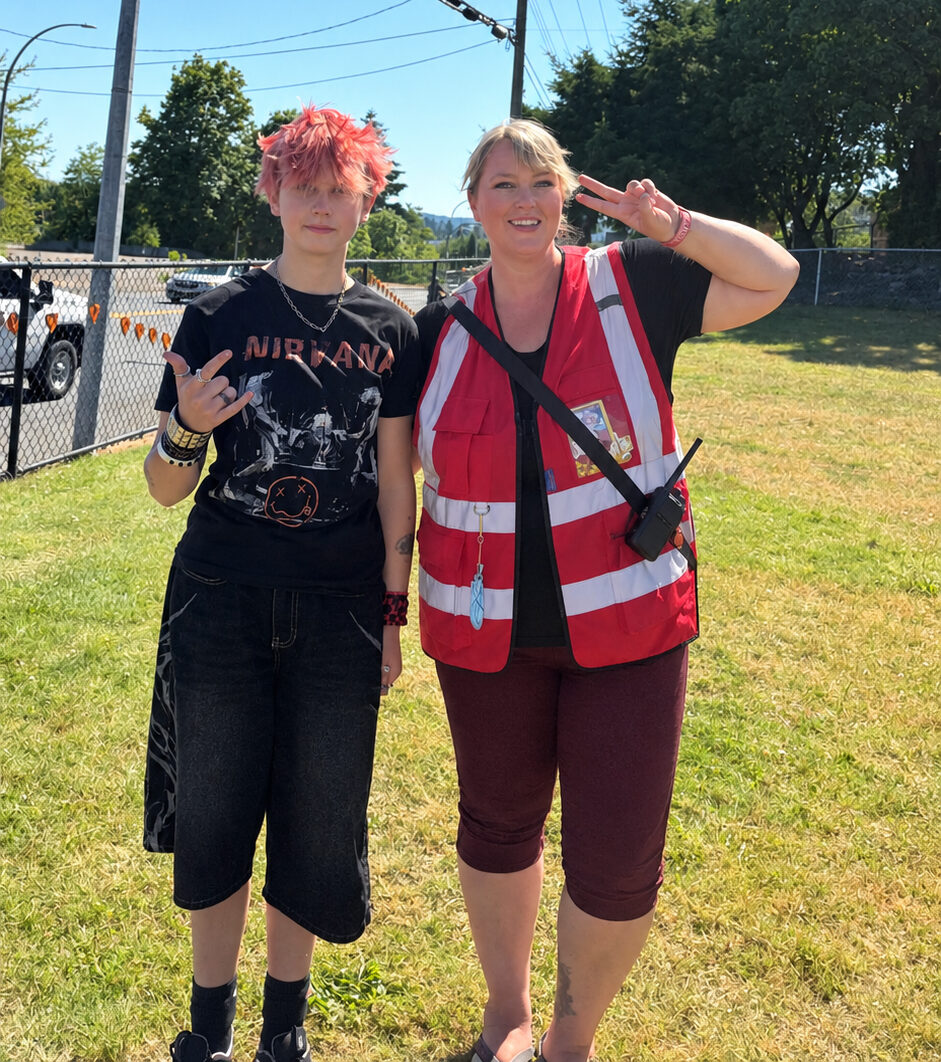
Education Assistant Sarah Lindskog during her first year in her new role in Nanaimo Ladysmith Public Schools.
By Mandy Moraes, NLPS Staff
A year ago, 20 aspiring students in NLPS’ EA training program Building Education Assistants through Mentorship (BEAM) were gathering practical learning and work experience.
Today, they’re working in classrooms across the school district, and some have found themselves in a variety of roles.
For Sorour Mozafary, the assignments started almost immediately. She worked at several schools before landing a temporary assignment at Fairview Community School, where she stayed for the remainder of the year. This fall, she returned in a permanent position.
BEAM introduced Mozafary to many of the situations she would encounter, from mobility support and communication devices to recognizing when a student is becoming escalated. But working alongside students every day has built her confidence in the role.
She also quickly learned how important relationships are.
“Building the relationship with kids is so much more important than just directing them,” she said.
Sarah Lindskog found her place at École Pauline Haarer, where she works across several classrooms. Some students need academic support or a quieter place to work, while others need one-on-one help. Moving between students means adjusting her approach throughout the day.
“Sometimes they do need you to be calm and relaxing, and they need you to be a safe space,” Lindskog said. “And then other times they need you to be … crazy and goofy and silly.”
The support system Lindskog spoke about while still in BEAM has also lasted beyond graduation. Members of the original cohort still have group chats, meet for dinner, and turn to each other for ideas.
For Jessica Lebrun, the first year led to a specialized role. After short assignments at Learning Alternatives and Chase River Elementary, she arrived at Rock City Elementary for what was initially expected to be five weeks. The assignment continued, eventually leading to a role supporting a single student.
Although the role has required additional specialized training and ASL classes, taking Lebrun beyond what BEAM had covered, she still finds herself returning to what she learned in the program, particularly how to recognize where a student is on the escalation continuum and how to adjust her approach accordingly.
For Lebrun, the past year has also shown her how much the smallest interactions can matter, and how seeing a smile on her student’s face makes the work worthwhile.
“There are little bits of joy there,” she said, “and I’m just so happy to be a part of even a little bit of happiness throughout the day.”