


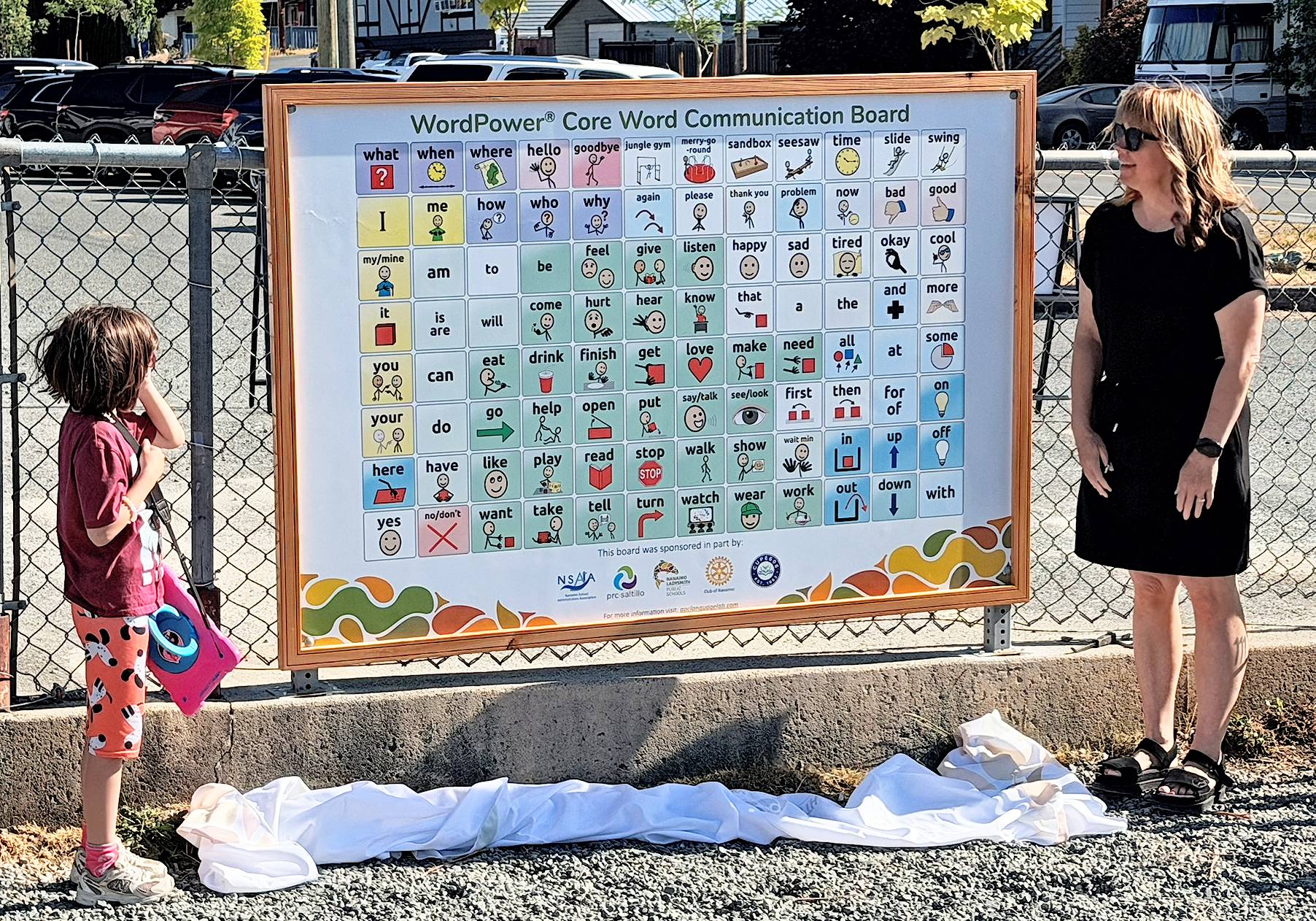
Inclusion support worker Elysha Boretsky, right, gets help unveiling the new communication board at Fairview Elementary on Monday, June 1.
By Mandy Moraes, NLPS staff
When students go outside for recess, they should still be able to communicate just like they do in the classroom.
This idea is at the heart of a new Nanaimo Ladysmith Public Schools initiative that will see Augmented and Alternative Communication (AAC) board installed at every school playground.
Inclusion support worker Elysha Boretsky started the project by asking an important question: How can students talk with each other on the playground if they don’t have their speech devices?
“A lot of our students go outside for recess without their speech devices,” Boretsky said. “Sometimes it’s because they’re running around and can’t safely carry an iPad. Sometimes the sun’s glare makes it hard for them to see the screen. Sometimes there isn’t someone available to supervise the device while they play.”
These weatherproof communication boards use pictures, symbols, and words to help students share what they want, need, think, and feel, featuring common words from everyday conversation, as well as playground-related words and symbols.
For example, a child might point to the symbols for “help” and “seesaw,” or show that they want to play on the slide. The boards give kids a way to communicate when speech devices aren’t practical.
To Boretsky, these boards mean much more than just new playground equipment.
“It’s a tool that supports inclusion and helps children have a voice,” she said.
The initiative was originally inspired by students who use augmentative and alternative communication (AAC) systems. Boretsky says it will also help many more students, including English language learners, younger students building language skills, and anyone who finds visual communication helpful.
“Really, they’re for everyone,” she said.
Boretsky had been thinking about this project for years. Even though she saw the need early on, she wasn’t initially sure it could happen across the entire school district.
The project started in January with the goal of raising enough money for just a few boards. At first, they had funding for three, but soon that grew to six. As more partners joined, the plan kept growing.
Support came from CUPE, the Rotary Club, PRC-Saltillo, and the Nanaimo School Administrators’ Association. Extra help from Kerri Steel, Director of Instruction for Inclusive Education, made it possible to bring the boards to every school in the district.
The communication boards are just one way NLPS is working to improve accessibility and inclusion. As we celebrate National AccessAbility Week and look back on the Accessibility Plan, the boards show that accessibility can take many forms.
“Ramps and buttons matter,” said Steel. “But accessibility is also about understanding that every classroom has a diverse group of children and everyone deserves what they need to access learning and feel connected.”
For Boretsky, the success of the project won’t be measured by the number of boards installed, but by the conversations they make possible.
What began as an idea to support a handful of students has grown into an initiative that will benefit learners of all abilities. By the time students return to school in the fall, communication boards will be waiting on playgrounds across NLPS, helping ensure that every child has a way to share their thoughts, express their needs, and take part in the social moments that make recess meaningful.